Wednesday, July 10, 2013

Nazrul and Dhumketu (contd-3)

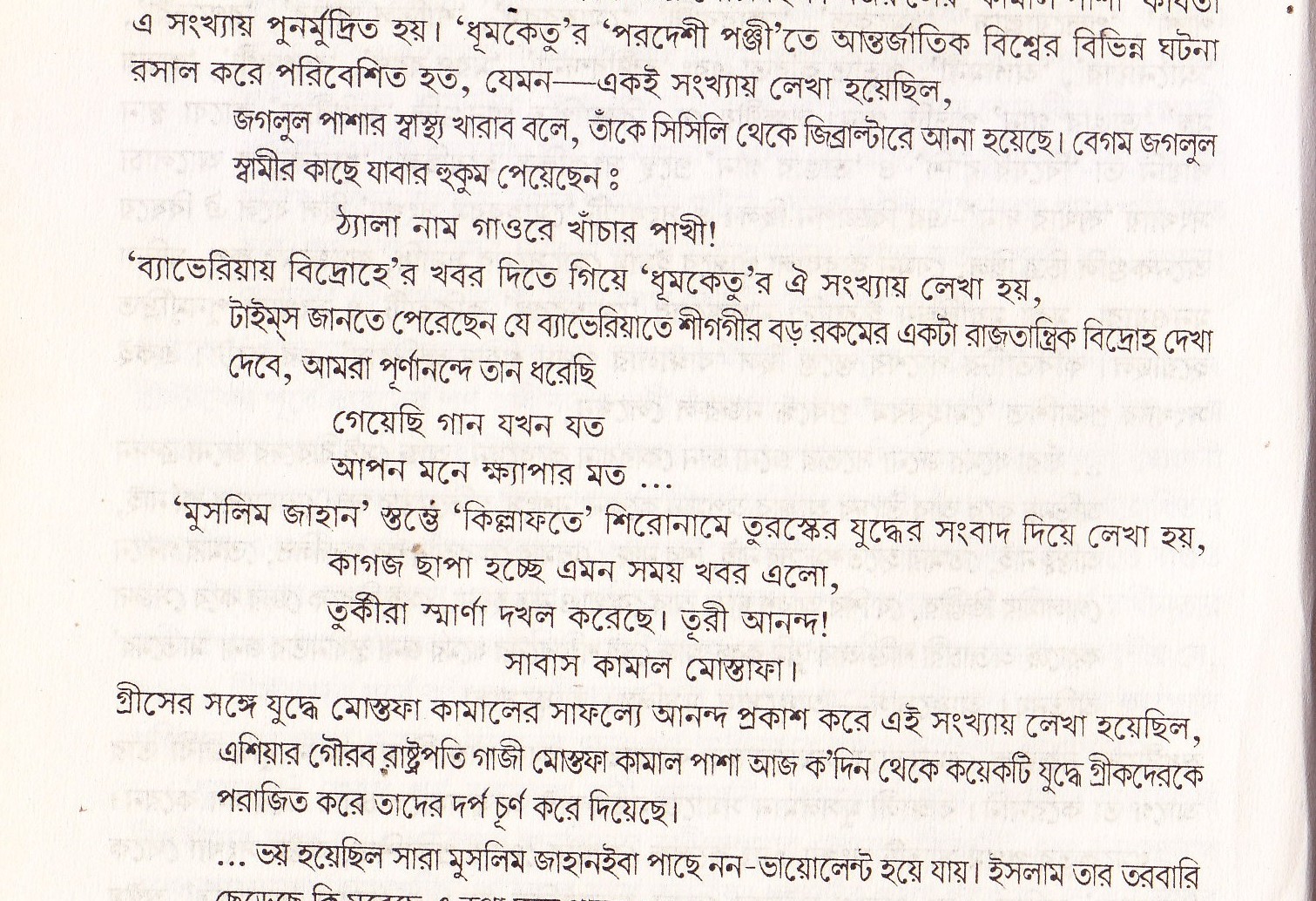
In the eighth issue of Dhumketu, the life of Jatindranath, Banglar biplab yuger pratham senanayak, was printed on the third page and on the fourth page, in the International Column (Pardeshi Panji) international issues    were published..
In the  Hangsadut column a letter written by the ex-revolutionary Barindra Kumar Ghosh was published. Nazrul addressed him as "bhanga banglar ranga yuger adi purohit Sagnik Beer"
Dhuketu served as the source of inspiration of not only Muslim Society but also the whole of Bengalee society. Gopinath Saha is the example of this inspiration who assassinated, by mistake, De Saheb instead of the Police Commissioner Tagert. This was described by Pabitra Gangopadhyay in the essay, "Dhumketur Nzrul". This incident showed the amount of inspiration that could develop in the minds of the youths of Bengal. The poet Kalidas Roy invited the arrival of Dhumketu by saying,
" Jago dhumketu Dhangser hetu
Swagata asiba Mahotsab,
Nazrul in his editorial column in 9th issue of Dhumketu said;

This was published in Dhumketu on 15th Sept 1922 in Hangsadut column.
The reactions of Dhumketu was perceived from the comments of the then news papers.Dainik Basumati and Atma Sakti  said;
In English daily Amrita Bazar Patrika on 30th Aug, 1922 gave more vivid comments on Nazrul's poem;
" We cordially welcome the advent of our new Bengali contempo-
Dhuketu was not only a symbol for destruction, it was also showed some sense of purity and ethics in its poem"Pralayollas" Why you are afraid of noticing destruction ? "
Two friendly papers of Dhumketu , "Prasun" and "Paridarshak" commented on Dhumketu, as also Achinta Kumar Sengupta in Kallol Yug  as follows;


Monday, July 8, 2013

Nazrul and Dhumketu (contd-2)

In 4th issue of Dhumketu a poem known as "Raktambardharani Ma". He wrote;

The seventh issue of Dhumketu was published on 5th Sept 1922 as Mahram Issue. In the fist page an advertisement of Agnibina was published mentioning publication of all heated and inspiring poems written by Nazrul, such as, Birohi, Kamal Pasa, Pralayollas, Dhumketu, Korbani, Mahram, Satil Arab, Ranabheri, Anwar, Agamoni etc and songs like Bandibandana, Maran Baean, Jagarani, Abhoy Mantra, Bhangar Gaan etc. The songs were published in Bisher Banshi, and Bhangar Gaan. Nazrul wrote in the essay Maharam; The first seven issues of Dhumketu was published from 3 n. College Square. from 8th issue , the office of Dhumketu was shifted to 7 no. Pratap Chatterjee Lane. this incident was mentioned as
" the centre of gravity of Dhumketu has been shifted to its new centre,"
In the eighth issue of Dhumketu, published on 12th Sept 1922 the life of " Banglar Biplab yuger Pratham Senanayak Purushsinha Jatindranath" was printed on the 3rd page.and in the "Pardeshi Panji" column different International matters were  printed. 


Saturday, July 6, 2013

Nazrul and Dhumketu (contd-1)


In every issue from the first one the blessings of Rabindranath Tagore was printed. (Pic-2 &3 in the margin)) The date of the blessings showed that Rabindranath was informed prior to the publication of "Dhumketu".Achintya kumar Sengupta wrote in Kallol Yug; (pic-4).
SaratChandra also sent his blessings towatds the success of Dhumketu. (pic-5).
Nazrul wrote a passionate poem in the first issue of Dhumketu. (Pic-6 & 7) in the editorial column "Sarathir pather khabar", 13 Oct 1922
on the demand of Complete Independence, (pic-8)
(pic-1)
(pic-2)
(Pic-3)
(pic-4)
(pic-5)
(Pic-6)
(pic-7)

(pic-8)
In 1921, in Ahmedabad Congress Moulana Hasarat Mohani
(Maulana Hasrat Mohani (b. 1875 Unnao, d. 1951 Lucknow) (Urdu: مولىٰنا حسرؔت موہانی‎ —Mọ̅lánā Ḥasrat Mōhānī) was a Romantic Poet of Urdu language, journalist, politician, parliamentarian of British India, besides a being a part of the Indian Independence Movement.
The real name of Maulana was Syed Fazl-ul-Hasan. Hasrat was his pen name which he used in the Urdu poetry and the word Mohani refers to the native place of Mohan where he was born)
Moulana Hasarat placed the demand of Complete Independence in the Ahmedabad Congress in 1921, and faced heavy opposition. He was also convicted in the court and got life-long imprisonment.It could be referred here that in 1929 Lahore Congress Pandit Jawaharlal Nehru placed the demend for Complete Independence. .
Dhumketu not only expressed the demand for Complete Independence , it supported the revolutionaries . The popularity of Dhumketu was comparable with Bijali of Barindra Kumar Ghosh and Atmasakti of Upendranath Mukhopadhyay.  Dr. Bhupen Dutta of Jugantar was deported from India,  Brahmmabandhab died in the jail and Nazrul got rigorous treatment  in jail for publishing Dhumketu.    

Nazrul and Dhuketu

Nazrul undrtook the responsibility of publication of "Nabayug" and "Sevak". Now he was going to undertake the responsibility of publication of another paper "Dhumketu".
A person , namely Hafiz Masud of Chittagang was willing to publish a paper and came to Muzaffar Ahmed and Nazrul for help. Muzaffar Ahmed didnot agree but Nazrul came forward and took the charge. For publication of paper Hafiz Masud collected Rs 250/- only.The name of the paper was fixed to be "Dhumketu". It would be published twice in a week and printed from Metcafe Press. The printer and publisher was Afzalul Haq, office of publication was 3, College Street, Calcutta. From 8th issue it was published from 7, Pratap Chatterjee Lane. All the arrangements for publication was done but Hafiz Masud didnot pay his promised money of Rs.250/-. He used to serve in the office of Police and paid only Rs.200/-.
The paper was published with the money received by  advance payment of some advertisement. The sole proprietor of the paper was Nazrul till he was not arrested . He handed over his charge to Biraja Sundari before he went to jail. From 1st to 7th issue Nazrul was the editor and from 8th issue he became the pilot.
Dhumketu was first published on and from 11th Aug 1922 (24th Shraban 1329) in 8 pages of 15x10 crown size paper. Price 1 anna , yearly Rs.5/-.After 4 issues the no. of pages was increased to 12 pages. The manager of the paper was Saktipada Sinha.      

Friday, July 5, 2013

Nazrul and "Bidrohi"

Nazrul wrote in his letter to Nargis, "Tumi ei aguner parasmani na dile Agnibina bajate partam na - ami dhumketur bismay niye udita hate partam na."
Really after the incident of Daulatpur Nazrul created some of his best creation  - Kamalpasa, Bidrohi, Pralayollas etc  and Bhangar Gaan.  Nazrul returned from Daulatpur in July 1921. He stayed for a few days in the office of the Sahitya Samity at College Street and then came to 3/4 Taltala Lane. Nazrul went to Santiniketan in Oct 1921 with Muhammad Saheedullah ( later Dr. Saheedullah). Sudhakant Roychoudhury, personal secretary of Rabindranath Tagore and a fan of Nazrul, once wrote a poem " Sainik Kaji Nazrul Sheber Prati" (published in kartik 1327, Moslem Bharat) to congratulate Nazrul Islam. He was the first person to bring  the notice of Rabindranath to a poem written by Nazrul. and made him introduced with Rabindranath. He was given the charge of loking after Nazrul when he came to Santiniketan. The visit of Nazrul and Dr. Saheedullah was described in a book, "Amar Kaishore Smritite Nazrul" (published in Katha Sahitya , Jaishtha 1377),  written by Nisikanta Roychoudhury, brother of Sudhakanta Roychoudhury.
Having returned from Santiniketan Nazrul and Muzaffar Ahmed was staying in 3/4 Taltala Lane. Two important things occurred, 1. Formation of Communist Party and 2. Creation of the poem "Bidrohi".While staying in Taltala Lane Nazrul and Muzaffar Ahmed had a communication through M.N.Roy from Moscow. In Taltala Lane, poets and litterateurs visited regularly. The Poet Satyendranath Dutta (Satyendranath Dutta (also spelt as Satyendranath Datta or Satyendra Nath Dutta) (Bengali: সত্যেন্দ্রনাথ দত্ত) (1882-1922), a Bengali poet, is considered the wizard of rhymes (or ছন্দের যাদুকর - chhonder jadukar in Bengali). Satyendranath Dutta was an expert in many disciplines of intellectual enquiry including medieval Indian history, culture, and mythology)  came to this house  to met Nazrul.
Nazrul wrote his famous poems Anowar, Kamal Pasa, Bhangar Gaan, And Bidrohi. Bidrohi was first published in "Bijali" in 6th Jan 1922 and then Moslem Bharat,  Pravasi etc. Nazrul waxs 22 yars old.

Tuesday, July 2, 2013

Nazrul, Daulatpur and Nargis

Nazrul was acquainted with Ali Akbar Khan in the office of the Bangiya Muslim Sahitya Samity at 32 College Street. Ali Akbar Khan was a writer and sales person of School Text Books. Nazrul wrote "Lichu Chor" for his text book.
He started for Coomillah with Ali Akbar by Chattagram Mail in the month of April 1921. He wrote in the train a poem "Nilpakhi" (pic-2), describing the typical scenery of East Bengal. This was the second time Nazrul came to East Bengal which he left in his teens. Ali Akbar Khan was a student of Coomillah District High School and a classmate of Birendra Kumar Sengupta, son of Indra Kumar Sengupta. Having reached Coomillah Nazrul went to Kandirparh in the house of Indra Kumar Sengupta. Biraja Sundari, the mother of  Birendra, was an affectionate lady and Ali Akbar called her "Ma". Nazrul, too, used to call her "Ma".
There were   other members in the family, two sisters of Birendra, viz, 1. Kamala (Bachchi), 2. Anjali (Jatu), the elder aunt of Birendra Giribala Devi and her daughter Pramila (Duli), wife of Birendra and his son, Rakhal. Indra Kumar Sengupta was an inspector of the wards of Coomillah court. His house was full of cultural environment. All the little girls of the house Duli, Bachchu, Jatu all knew how to sing. Nazrul got acquainted with them very rapidly.
After a few days Nazrul went with Ali Akbar to his village at Daulatpur. The senior member of his house was his elder sister. His another elder sister was married to Munsi Abdul  Khalek of near by village working in marine. She was also an widow and used to come to Ali Akbar's house with her daughter Saiyada Khatun, an unmarried girl., everyday.
Nazrul became close with Saiyad Khatun, alias Nargis. Nargis liked Nazrul for his playing of flute.
In Daulatpur Nazrul wrote many poems in the mnths of Baishakh and Jaishthya and published them in Chanat Kabya Grantha. Both Nazrul and Nargis became close each and fell in love. At the initiative of Ali Albar Khan their marriage was settled and the date was fixed to be 3 Asharh (June) 1921, He brought Saiyada Khatun in his house. Saiyada Khatun read in a primary school. To make her suitable for Nazrul Aliakbar made her to read Saratchandra's book. Everything was finalised but the marriage did not took place and was dismissed on the moment of taking the oath for some conditions laid down by Aliakbar in the contract paper where it was written that Nazrul had to here with Nargis and would not take Nargis to any other place.
Nazrul had to retreat from the place on the day of the marriage in the heavy rains.
Nazrul came to Coomillah in the house of Biraja Sundari Devi and wrote a letter to Muzaffar Ahmed informing that he had been cheated by Alakbar khan and asked him to send some money as he was not fit to move.
Muzaffar Ahmaed came to Nazrul in Coomillah and took  him to Calcutta on 8th July. Nazrul came to Coomillah-Daulatpur in the month of April 1921 and returned to Calcutta July  1921.
At first Nazrul met Afzalul Haq Saheb and stayed in the office of Bangiya Musalman Sahitya Samity at 32 CFollege Street and then came to 3/4 Taltala Lane with Muzaffar Ahmed.
Saiyada Khatun was subseuently married with the poet Azizul Hakim.
After about fifteen years of leaving Daulatpur, Nazrul in reply to a letter written by Nargis to him, wrote addressing her "Kalyaniyesu"; " if you rely on hears say then you will misunderstand me.....My heartfelt god knows that how much pain I had to bear on that day, so that the wound is still giving me pain......."
Nazrul confessed his letter that the pain inspired him to write "Bidrohi" published in Agnibina. In one night he wrote "Bidrohi" in 3/4 Talatala Lane. He als wrote, Anoar, Kamalpasa,mBhangar gaan etc .        

Monday, July 1, 2013

Nazrul in Deoghar


Nazrul Islam gave up all connections with Nabayug in Dec 1920, at the advice of two persons seemed  to be his friends, 1. the person in charge  of the paper "Moslem Bharat", Afzalul Haq, and 2. The writer of text books for children , Ali Akhbar Khan. They inspired Nazrul to go to Deoghar for a change weather. They thought that if Nazrul would have been detached from Nabayug, he would find time  and could find sufficient time for writing for other publications. They might fulfill their own requirements.With that expectation  they committed to bear the expenses of Nazrul's tour programme. They also arranged a farewell ceremony of Nazrul's departure. Mr. Afzalul Haq in his address committed that he would remit Rs. 100/- p.m. during the period Nzrul would stay in Deoghar. In exchange to this Nazrul would supply all his writings written during this time to "Moslem Bharat" for publication. Nazrul left Calcutta for Deoghar (pic. in the margin).
One funny thing happened in the train when Nazrul was moving for Deoghar. Some Pandas appeared and captured Nazrul and fetched him upto their dwellings. Nazrul had to open his box to show them the type of his dresses including typical caps of Muslims (Serwani) to prove that he was a muslim. When they became convinced, they took him to the house of Rajnarayan Basu in Deoghar. Rajnarayan Basu was the maternal grand father of Baridra Kumar Ghosh. Nazrul passed his first night at Deoghar in the house of Manindra Basu, the son of Rajnarayan Basu. Then he hired a cottage in the Sanatorium of Kartick Basu, the elder brother of Sachindra Basu the editor of "Byabsa-banijya". Kumudini Basu, daughter of Krishna Kumar Mitra, the editor of "Sanjibani,   wife of Sachindra Basu and grand daughter of Rajnarayan Basu, ex-editor of Supravat,  was in Deoghar at that time.
Nazrul had good times in deoghar with  the litterateurs.
In the mean time an incident happened. Once in the night a young man came with a young lady and begged  from Nazrul a permission to stay for one night. Thinking that they were married couple Nazrul allowed  them to stay for one night. But soonafter their departure it bwas revealed that they were not married . The whole Deoghar took it as an exception and Kumudini Basu became annoyed with this behavior and refused talking with Nazrulk.. After some time, of course, Kumudini made to understand that Nazrul was not responsible for this nasty affairs.She wanted to revive their good relations. But Nanzrul did not agree.
Nazrul could not create more literature as was expected by Afzalul Haq and Aliakbar Khan. He constructed only four songs. For this Afzalul did not send money as he promised to do. Nazrul wrote a letter to his friend Pabitra Gangopadhyay saying ;
" now I am Penniless and ask Afzalul to send money . If they send money today it will not go astray."Lastly Muzaffar Ahmed saved the situation.
Nazrul again joined for a short periiod in Nabayug orgaised by the political leader of Burdwan, Abul Kasem. After some time he went to Coomillah-Daulatpur accompanying Aliakbar Khan.