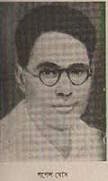
Varahagiri Venkata Giri ( 10 August 1894 – 23 June
1980), commonly known as V. V. Giri, was the fourthPresident of the
Republic of India from 24 August 1969 to
23 August 1974. He served as Acting
President of India from 3 May 1969 to 20 July 1969, before getting elected.
He was born to Varahagiri Venkata Jogaiah in a NiyogiTelugu Brahmin family, residing in
Brahmapur (Berhampur) in the Ganjam district of the erstwhile Madras Presidency.
The town and district are now part of the state of Odisha. His father was an eminent lawyer and migrated to
Brahmapur from Chintalapalli village, now part of East Godavari District - Andhra Pradesh State.
In 1913, he went to University College Dublin to study
law, but was expelled from Ireland in 1916 after becoming involved with the Sinn Féin movement.[citation
needed] Involvement which brought him into close contact
with Éamon de
Valera, Michael Collins, Patrick Pearse, Desmond FitzGerald, Eoin MacNeill, James Connolly and others.
Upon returning to India, he became heavily involved in the labour movement,
becoming general secretary and then president of the All-India Railwaymen's
Federation and twice serving as president of the All-India Trade Union
Congress.
Giri became a member of the Imperial Legislative Assembly in
1934.
In the 1936 General Election in Madras, Giri was put up as the Congress
candidate in Bobbili against the Raja of Bobbili and he won that election. He became minister of
labour and industries in 1937 for the Congress Party government formed by C. Rajagopalachari in the
Madras
Presidency. When the Congress governments resigned in 1942, he returned to
the labour movement as part of the quit India movement and was imprisoned by
the British. He was lodged
in Rajahmundry jail.
After India gained independence, he was first appointed high commissioner to
Ceylon and then
successfully ran for parliament in 1952. He was elected for 1st Lok Sabha from Pathapatnam Lok Sabha
Constituency and served as
minister of labour until resigning in 1954. The
Indian Society of Labour Economics (ISLE) was founded in 1957 by a
distinguished group of academicians and public men engaged in promoting the
study of labour and industrial relations. The team was headed by Shri Giri.
He served successfully as governor of Uttar Pradesh (1956–1960), Kerala (1960–1965) and Mysore (1965–1967).
He was elected as the thirdVice
President of India in 1967. Giri became Acting President of India in May
1969 upon the death in office of President Zakir Hussain. The official Congress
candidate for the presidential election of 1969 was Neelam Sanjiva Reddy.
However, Giri filed his papers as an independent candidate and enjoyed the tacit
support of the Prime Minister, Indira Gandhi. A third candidate in that election
was C D Deshmukh who was supported by right wing opposition parties. In a
closely contested election, none of the candidates won an outright majority of
the preferential votes. On counting the second preferential votes, Giri emerged
the winner. He was sworn in on
28 August 1969 and held office till 28 August, 1974.
26 Oct 1890 Hathgam or Hathgaon: This is also
block headquarter and birth place of great freedom fighter Late Shri Ganesh
Shankar Vidyarthi & renowned Urdu poet Shri Iqbal Verma. It is said, this
was populated by Saint Parashar.
His short life was a constant struggle against oppression and inhumanity. He
described himself in these words: "I am a fighter against oppression and
injustice, whether practised by bureaucrats, zamindars, capitalists or those of
high caste. I have fought all my life against oppression against inhumanity and
may God give me strength to fight on till the last.".
Ganesh Shankar was born at Hathgaon/Hathgam. This is also the birthplace of
renowned Urdu poet Shri Iqbal Verma and it is said, this was populated by Saint
Parashar. His father Shri Jai Narain was a teacher in a middle school in Madhya
Pradesh. He was poor but deeply religious and dedicated to high ideals. It was
under him that Ganesh Shankar received his early schooling and passed the High
School examination privately in 1907. He could not study further due to poverty
and became a clerk in the currency office and later a teacher in high school in
Kanpur.
His real interest, however, was in journalism and public life and he came
early under the influence of the nationalist upsurge, which was taking place in
the country. He became an agent of the well-known revolutionary Hindi and Urdu
journals - Karamyogi and Swarajya and also began to contribute to them. He
adopted the pen-name 'Vidyarthi' - the seeker of knowledge. He attracted the
notice of Pt. Mahabir Prasad Dwiwedi, the doyen of Hindi journalism who offered
him the job of a sub-editor in his famous literary monthly, "The Saraswati", in
1911. Ganesh Shankar, however, was more interested in current affairs and
politics and therefore joined the Hindi weekly "Abhyudaya" a political journal
of the time. He thus served his apprenticeship under two of the greatest figures
in Hindi literature and journalism of the time.
In 1913 Ganesh Shankar came back to Kanpur and launched his career of a
crusading journalist and freedom fighter, which was only to end with his death
18 years later. He founded 'Pratap', his famous revolutionary weekly, which
identified itself with the cause of the oppressed wherever they might be. It was
through this paper that he waged his famous fights for the oppressed peasants of
Rae Bareli,
the workers of the Kanpur mills and the
downtrodden people of Indian states. During the course of these fights he had to
face numerous prosecutions, pay heavy fines and suffer five prison sentences. He
first met Gandhiji in 1916 in Lucknow and threw himself whole-heartedly in the
national movement. He took a leading part in the Home Rule Movement of 1917-18
and led the first strike of textile workers in Kanpur. In 1920 he launched the
daily edition of Pratap and it was in this year that he was sentenced to
two years rigorous imprisonment for championing the cause of peasants of Rae
Bareli. He was released in 1922 and almost immediately sent to jail again, for
delivering a "seditious" speech as the President of the Provincial Political
Conference at Fatehgarh. He was released in 1924, greatly shattered in health,
but he knew no respite and immediately launched himself in the preparation for
the Congress Session at Kanpur in 1925.
In 1925, when the Congress decided to contest elections of Provincial
Legislative Councils and organised the Swaraj Party, Ganesh Shankar won a
resounding victory on its behalf, from Kanpur and served as a Member of the U.P.
Legislative Council till 1929 when he resigned at the behest of the Congress. In
1929 he was elected the President of the U.P. Congress Committee and was
appointed the first 'dictator' to lead the Satyagrah movement in U.P. In 1930,
and was arrested and sent to jail again. He was released on March 9, 1931 under
the Gandhi-Irwin Pact.
While he was about to proceed to Karachi to attend the Congress Session,
Kanpur fell into an orgy of communal rioting. Ganesh Shankar Vidyarthi threw
himself in the midst of furious mobs and saved the lives of thousands of
innocent persons belonging to both the Hindu and Muslim communities. It was on
this mission of mercy that he was butchered to death by a mob.
Mahatma Gandhi paid him the following tribute in the pages of 'Young India'.
"The death of Ganesh Shankar Vidyarthi was one to be envied by us all. His blood
is the cement that will ultimately bind the two communities. No pact will bind
our hearts. But heroism such as Ganesh Shankar Vidyarthi showed is bound in the
end to melt the stoniest hearts, melt them into one. The poison has however gone
so deep that the blood even of a man so great, so self-sacrificing and so
utterly brave as Ganesh Shankar Vidyarthi may today not be enough to wash us of
it. Let this noble example stimulate us all to similar effort should the
occasion arise again."
Ganesh Vasudev Mavalankar (27 November 1888 – 27 February 1956) popularly
known as Dadasaheb was an independence activist, the President
(from 1946 to 1947) of the Central Legislative Ganesh Vasudev was born in District Ratnagiri of Maharashtra.
Assembly, then
Speaker of the Constituent Assembly of India,
and later the first Speaker of the Lok Sabha, the lower house of the Parliament of
India. His son Purushottam Mavalankar was later elected to the Lok Sabha
twice from Gujarat.
Mavalankar hailed from a Marathi family but lived and worked in Ahmedabad, former capital of Gujarat. His family originally belonged
to Mavalange in Ratnagiri district of Bombay Presidency
in British
India. After his early education in Rajapur and other places in Bombay Presidency,
Mavalankar moved to Ahmedabad in 1902 for higher studies. He obtained his B.A.
Degree in Science from the Gujarat College, Ahmedabad, in 1908. He was
a Dakshina Fellow of the College for one year in 1909 before beginning his law
studies in Government Law School, Bombay. He passed his Law examination in First
Class in 1912 and entered the legal profession in 1913. Soon. he came into
contact with eminent leaders like Sardar
Vallabhbhai Patel and Mahatma Gandhi. He became the honorary secretary
of the Gujarat Education Society in 1913 and the secretary of the Gujarat Sabha
in 1916. Mavalankar was elected to the Ahmedabad Municipality for the first time
in 1919. He was a member of the Ahmedabad Municipality during 1919–22, 1925–28,
1930–33 and 1934–37.
Political Life
He gave up his legal profession and joined the freedom movement of India in 1921.
Mavalankar joined the Indian Independence Movement with
the Non-Cooperation Movement. He was
appointed secretary of the Gujarat Provincial Congress Committee during 1921–22.
Although he temporarily joined the Swaraj Party in the 1920s, he returned to Mahatma Gandhi and the Salt
Satyagraha in 1930. After the Congress abandoned its boycott of elections to the pre-independence
legislative councils in 1934, Mavlankar was elected to the Bombay Province
Legislative Assembly and became its Speaker in 1937. Mavalankar remained Speaker
of the Bombay Legislative Assembly from 1937 to 1946. In 1946, he was elected
also to the Central Legislative Assembly.
Mavalankar remained the President of the Central Legislative Assembly till
the midnight of August 14–15, 1947 when, under the Indian Independence Act 1947, the
Central Legislative Assembly and the Council of States ceased to exist and the
Constituent Assembly of India
assumed full powers for the governance of India. Just after independence,
Mavalankar headed a committee constituted on 20 August 1947 to study and report
on the need to separate the Constitution-making role of the Constituent Assembly
from its legislative role. Later, on the basis of this Committee's
recommendation, the legislative and Constitution-making roles of the Assembly
were separated and it was decided to have a Speaker to preside over the Assembly
when during its functioning as the legislative body. Mavalankar was elected to
the office of speaker of the Constituent Assembly (Legislative) on 17 November
1947. With the adoption of the Constitution of India on 26 November
1949, the nomenclature of the Constituent Assembly (Legislative) was changed to
the Provisional Parliament. Mavalankar became the Speaker of the Provisional
Parliament on 26 November 1949 and continued to occupy the office till the 1st Lok Sabha was
constituted in 1952.
On 15 May 1952, after the first general elections in independent India,
Mavalankar was elected the Speaker of the 1st Lok Sabha. The House
carried the proposal with 394 votes, against the opponent's 55. In January 1956,
Mavalankar suffered a cardiac arrest and died on 27 February 1956 in
Ahmedabad.
Ganesh Ghosh (Bengali: গণেশ
ঘোষ) (June 22, 1900 – October 16, 1994) was a BengaliIndian independence activist, revolutionary and
politician. Ganesh Ghosh was born in the village Binodpur of Jessore District, present Bangladesh.
Ganesh Ghosh hailed from Chittagong, now in Bangladesh. His father was an employee in Railway. In 1922, he took admission in the Bengal
Technical Institute in Calcutta. he was arrested in 1923 in the case of Maniktala Bomb Case. He was imprisoned without any trial for four years in 1924. he was elected as a member of Bengal Provincial Congress committee in 1929. Later, he became a member of the Chittagong Jugantar party. He participated in the
Chittagong armoury raid, along with Surya Sen and other revolutionaries
on April 18, 1930. He was arrested from a secret shelter in Chandanagar.
After the trial, Ganesh Ghosh was deported to the Cellular Jail in Port Blair in 1932 for life imprisonment.. After the release from jail in
1946, he joined communist politics and became a member of the Communist
Party of India. After the independence, he became a leader of the party.
After the split in Communist Party of India in 1964,
Ganesh sided with the Communist Party of India
(Marxist). He was elected to the West Bengal Legislative
Assembly in 1952, 1957 and 1962 as a Communist Party of India candidate from
Belgachia. He was
elected to the 4th Lok
Sabha in 1967 from Calcutta South Lok Sabha
constituency as a Communist Party of India (Marxist) candidate.In the 1971
Lok Sabha he was again the Communist Party of India (Marxist) candidate from
Calcutta South Lok Sabha constituency. This time he was defeated by 26 year old
Priya Ranjan Dash Munshi who won his first Lok Sabha election fighting on
Congress(R) ticket.
he died in Woodburn Ward of S.S.k.m. hospital being bedridden in a serious disease.
Ghaffar Khan was born into a generally peaceful and prosperous family from Utmanzai in NWFA, Peshawar Valley of British Indiawas an independence activist of
Pashtun descent. He
was a political and spiritual leader known for his nonviolent opposition to the British Raj in British India, and a
lifelong pacifist and devout Muslim. A close friend of Mahatma Gandhi, Bacha
Khan has been called the "Frontier Gandhi" by the Indians.
His father, Bahram Khan, was a
land owner in the area commonly referred to as Hashtnaggar. Ghaffar was the
second son of Bahram to attend the British run Edward's mission school since
this was the only fully functioning school because it was run by missionaries.
At school the young Ghaffar did well in his studies and was inspired by his
mentor Reverend Wigram to see the importance of education in service to the
community. In his 10th and final year of high school he was offered a highly
prestigious commission in The Guides, an elite corp of Pashtun soldiers of the
British
Raj. Young Ghaffar refused the commission after realising even Guide
officers were still second-class citizens in their own country. He resumed his
intention of University study and Reverend Wigram offered him the opportunity to
follow his brother, Dr. Khan Sahib, to study in London. An
alumnus of Aligarh Muslim University, he
eventually received the permission of his father, Ghaffar's mother wasn't
willing to lose another son to London—and their own culture and religion. So
Ghaffar began working on his father's lands while attempting to discern what
more he might do with his life.
In response to his inability to continue his own education, Ghaffar Khan
turned to helping others start theirs. Like many such regions of the world, the
strategic importance of the newly formed North-West Frontier Province (now Khyber
Pakhtunkhwa, Pakistan) as a
buffer for the British Raj from Russian influence was of little
benefit to its residents. The oppression of the British, the repression of the
mullahs, and an ancient culture of violence and vendetta prompted Ghaffar to
want to serve and uplift his fellow men and women by means of education. At 20
years of age, Ghaffar opened his first school in Utmanzai. It was an instant success and he
was soon invited into a larger circle of progressively minded reformers.
While he faced much opposition and personal difficulties, Ghaffar Khan worked
tirelessly to organize and raise the consciousness of his fellow Pushtuns.
Between 1915 and 1918 he visited 500 villages in all part of the settled
districts of Khyber-Pakhtunkhwa. It was in this frenzied activity that he had
come to be known as Badshah (Bacha) Khan (King of Chiefs).
He married his first wife Meharqanda in 1912; she was a daughter of Yar
Mohammad Khan of the Kinankhel clan of the Mohammadzai tribe of Razzar, a
village adjacent to Utmanzai. They had a son in 1913, Abdul Ghani Khan, who
would become a noted artist and poet. Subsequently, they had another son, Abdul
Wali Khan (17 January 1917–), and daughter, Sardaro. Meharqanda died during the
1918 influenza
epidemic. In 1920, Abdul Ghaffar Khan remarried; his new wife, Nambata, was
a cousin of his first wife and the daughter of Sultan Mohammad Khan of Razzar.
She bore him a daughter, Mehar Taj (25 May 1921–29 April 2012), and a son, Abdul Ali
Khan (20 August 1922-19 February 1997). Tragically, in 1926 Nambata died early
as well from a fall down the stairs of the apartment they were staying at in
Jerusalem.
Khudai Khidmatgar
Khudai Khidmatgar
In time, Ghaffar Khan's goal came to be the formulation of a united,
independent, secular India. To achieve this end, he founded the Khudai
Khidmatgar ("Servants of God"), commonly known as the "Red Shirts"
(Surkh Posh), during the 1920s.
The Khudai Khidmatgar was founded on a belief in the power of Gandhi's
notion of Satyagraha, a form of
active non-violence as captured in an oath. He
told its members:
"I am going to give you such a weapon that the police and the army will not
be able to stand against it. It is the weapon of the Prophet, but you are not
aware of it. That weapon is patience and righteousness. No power on earth can
stand against it."
The organization recruited over 100,000 members and became legendary in
opposing (and dying at the hands of) the British-controlled police and army.
Through strikes, political organisation and non-violent opposition, the
Khudai Khidmatgar were able to achieve some success and came to dominate
the politics of Khyber-Pakhtunkhwa. His brother, Dr. Khan Abdul
Jabbar Khan (known as Dr. Khan Sahib), led the political wing of the
movement, and was the Chief Minister of the province (from the late
1920s until 1947 when his government was dismissed by Mohammad Ali
Jinnah of the Muslim League).
Ghaffar Khan forged a close, spiritual, and uninhibited friendship with Mahatma Gandhi, the
pioneer of non-violent mass civil disobedience in India. The two had a deep
admiration towards each other and worked together closely till 1947.
The Khudai Khidmatgar (servants of god) agitated and worked cohesively
with the Indian National Congress, the leading
national organization fighting for freedom, of which Ghaffar Khan was a senior
and respected member. On several occasions when the Congress seemed to disagree
with Gandhi on policy, Ghaffar Khan remained his staunchest ally. In 1931 the
Congress offered him the presidency of the party, but he refused saying, "I am a
simple soldier and Khudai Khidmatgar, and I only want to serve." He remained a
member of the Congress Working Committee for many years, resigning only in 1939
because of his differences with the Party's War Policy. He rejoined the Congress
Party when the War Policy was revised.
On April 23, 1930, Ghaffar Khan was arrested during protests arising out of
the Salt Satyagraha. A crowd of Khudai Khidmatgar
gathered in Peshawar's Kissa Khwani (Storytellers)
Bazaar. The British ordered troops to open fire with machine guns on the
unarmed crowd, killing an estimated 200–250. The Khudai
Khidmatgar members acted in accord with their training in non-violence under
Ghaffar Khan, facing bullets as the troops fired on them. Two platoons of
the The Garhwal
Rifles regiment refused to fire on the non-violent crowd. They were later
court-martialled with heavy punishment, including life imprisonment.
Ghaffar Khan was a champion of women's rights and nonviolence. He became a
hero in a society dominated by violence; notwithstanding his liberal views, his
unswerving faith and obvious bravery led to immense respect. Throughout his
life, he never lost faith in his non-violent methods or in the compatibility of
Islam and nonviolence. He viewed his
struggle as a jihad with only the enemy
holding swords. He was closely identified with Gandhi because of his
non-violence principles and he is known in India as the 'Frontier Gandhi'. One of his Congress associates was Pandit
Amir Chand Bombwal of Peshawar.
"O Pathans! Your house has fallen into ruin. Arise and rebuild it, and
remember to what race you belong." – Ghaffar Khan
Mahatma Gandhi and Khan Abdul Ghaffar Khan with a
leader of the Khaksar Tehrik (founded by Allama Mashriqi). Photo
was taken in Peshawar on May 06, 1938.
Ghaffar Khan strongly opposed the partition of India. While many Pashtuns (particularly the Red Shirts) were willing to
work with Indian politicians, many other Pashtuns were sympathetic to the idea
of a separate homeland for India's Muslims following the departure of the
British. Targeted with being Anti-Muslim, Ghaffar Khan was attacked in 1946,
leading to his hospitalization in Peshawar.
The Congress party refused last-ditch compromises to prevent the partition,
like the Cabinet Mission plan and Gandhi's suggestion to
offer the Prime Ministership to Jinnah. As a result, Ghaffar Khan and his
followers felt a sense of betrayal by both Pakistan and India. Ghaffar Khan's
last words to Gandhi and his erstwhile allies in the Congress party were: "You
have thrown us to the wolves."
When the referendum over accession to Pakistan was held, Ghaffar Khan and the
Indian National Congress Party
boycotted the referendum. As a result, in 1947 the accession of Khyber-Pakhtunkhwa to Pakistan was made
possible by a majority. A loya
jirga in the Tribal Areas also garnered a similar result as most
preferred to become part of Pakistan. Ghaffar Khan and his Khudai Khidmatgars,
however, chose to boycott the polls along with other nationalistic Pakhtuns.
Some have argued that a segment of the population voted was barred from
voting,.
Ghaffar Khan took the oath of allegiance to the new nation of Pakistan on 23
February 1948 at the first session of the Pakistan Constituent Assembly.
Ghaffar Khan walking with Jawaharlal Nehru
after the Cabinet Mission, 1946.
He pledged full support to the government and attempted to reconcile with the
founder of the new state Muhammad Ali Jinnah. Initial overtures led to a
successful meeting in Karachi, however a follow-up meeting in the Khudai
Khidmatgar headquarters never materialised, allegedly due to the role of
Khyber-Pakhtunkhwa Chief Minister, Abdul Qayyum Khan who warned Jinnah that
Ghaffar Khan was plotting his assassination.
Following this, Ghaffar Khan formed Pakistan's first National opposition
party, on 8 May 1948, the Pakistan Azad Party. The party pledged to play the
role of constructive opposition and would be non-communal in its philosophy.
However, suspicions of his allegiance persisted and under the new Pakistani
government, Ghaffar Khan was placed under house arrest without charge from 1948
till 1954. Released from prison, he gave a speech again on the floor of the
constituent assembly, this time condemning the massacre of his supporters at Babrra.
"I had to go to prison many a time in the days of the Britishers. Although we
were at loggerheads with them, yet their treatment was to some extent tolerant
and polite. But the treatment which was meted out to me in this Islamic state of
ours was such that I would not even like to mention it to you."
He was arrested several times between late 1948 and in 1956 for his
opposition to the One Unit
scheme. The government
attempted in 1958 to reconcile with him and offered him a Ministry in the
government, after the assassination of his brother, he however refused. He remained in
prison till 1957 only to be re-arrested in 1958 until an illness in 1964 allowed
for his release.
In 1962, Abdul Ghaffar Khan was named an "Amnesty International Prisoner of the
Year". Amnesty's statement about him said, "His example symbolizes the suffering
of upward of a million people all over the world who are prisoners of
conscience."
In September 1964, the Pakistani authorities allowed him to go to United Kingdom for
treatment. During winter his doctor advised him to go to United States. He then went
into exile to Afghanistan, he returned from exile in December 1972 to a popular
response, following the establishment of National Awami Party provincial
government in Khyber-Pakhtunkhwa and Balochistan.
He was arrested by Prime Minister Zulfiqar Ali
Bhutto's government at Multan in November 1973 and described Bhuttos
government as "the worst kind of dictatorship".
In 1984, increasingly withdrawing from politics he was nominated for the
Nobel Peace Prize. He visited India
and participated in the centennial celebrations of the Indian National Congress
in 1985; he was awarded the Jawaharlal
Nehru Award for International Understanding in 1967 and later Bharat Ratna, India's highest
civilian award, in 1987.
His final major political challenge was against the Kalabagh
dam project, fearing that the project would damage the Peshawar valley, his
hostility to it would eventually lead to the project being shelved after his
death.
Ghaffar Khan died in Peshawar under house arrest in 1988 and was buried in
his house at Jalalabad, Afghanistan, and over 200,000
mourners attended the funeral, including the Afghan president Mohammad
Najibullah. This was a symbolic move by Ghaffar Khan, as this would allow
his dream of Pashtun unification to live even after his death. The then Indian
Prime Minister Rajiv Gandhi had gone to Peshawar, to pay his tributes to Khan
Abdul Ghaffar Khan in spite of the fact that General Zia-ul-Haq had tried to
stall his attendance citing security reasons, also the Indian government
declared a five-day period of mourning in his honour.
Although he had been repeatedly imprisoned and persecuted, tens of thousands
of mourners attended his funeral, described by one commentator as a caravan
of peace, carrying a message of love from Pashtuns east of the Khyber to
those on the west, marching
through the historic Khyber
Pass from Peshawar to Jalalabad. A cease-fire was announced in the Afghan
Civil War to allow the funeral to take place, even though it was marred by
bomb explosions killing 15.
Political legacy
His eldest son Ghani Khan was a poet, his other son Khan Abdul Wali
Khan is the founder and leader of the Awami National Party and was the Leader of
the Opposition in the Pakistan National Assembly.
His third son Khan Abdul Ali Khan was non-political and a
distinguished educator, and served as Vice-Chancellor of University of
Peshawar. Ali Khan was also the head of Aitchison College, Lahore and Fazle Haq college, Mardan. Mohammed Yahya
Education Minister of N W F Province, was the only son in law of Khan Abdul
Ghaffar Khan. Asfandyar
Wali Khan is the grandson of Khan Abdul Gaffar Khan, and leader of the Awami
National Party, the party in power in Khyber-Pakhtunkhwa till May 2013 elections
in which it defeated badly. Salma
Ataullahjan is the great grand niece of Khan Abdul Gaffar Khan and a member
of the Senate of
Canada.
Abdul Ghaffar Khan's political legacy is mixed he is renowned amongst
Pashtuns, Indians and internationally as a leader of a non-violent movement. He
is credited with his tireless advocacy of peace in the region he belonged to.
However, within Pakistan, there is a large section of society which still has
not come to grips with his siding with the All India Congress over the Muslim
League as well as his opposition to Mr. M. A. Jinnah who is revered in Pakistan
as the father of the nation. In particular people have questioned Ghaffar Khan's
patriotism following his insistence that he be buried in Afghanistan after his
death and not Pakistan. However, this view is opposed by the fact that he is an
ethnic Pashtun, with there being officially no boundary between ancient
northwest India and Afghanistan, hence being buried in the 'land of Pashtuns'
(literal translation from Old Farsi) is a significant sign of his patriotism
towards his ethnic roots as a Pashtun. Others ask how one's choice of burial
place is an indication of one's Patriotism since a better indicator is one's
actions while living and even though Khan Abdul Ghaffar Khan spent half of his
98 year life in jail most of it in Pakistani jails doing hard labor he continued
to reside in Pakistan.
Film, literature
and society
In 2008, a documentary, titled The Frontier Gandhi: Badshah Khan, a Torch for
Peace, by filmmaker and writer T.C. McLuhan, premiered in New York. The
film received the 2009 award for Best Documentary Film at the Middle East International
Film Festival .
In Richard Attenborough's 1982 epic Gandhi, Khan Abdul Ghaffar Khan was portrayed
by Dilsher
Singh.
Ghaffar Khan was listed as one of 26 men who changed the world in a recent children's
book published in the United States. He also wrote an
autobiography (1969), and has been the subject of biographies by Eknath Easwaran (see article) and Rajmohan Gandhi (see
"References" section, below). His philosophy of Islamic pacificism was
recognised by US Secretary of State Hillary Clinton, in a speech to American
Muslims.
In the Indian city of Delhi, the
popular Khan Market is named
in honour of Khan Abdul Ghaffar Khan, and another market in the Karol Bagh of New Delhi is named
after him called Ghaffar
Market Vibhu
Puri is reportedly making a Bollywood Biopic on the life of Khan Abdul
Ghaffar Khan titled Chenab Gandhi.
Peshawar International Airport was renamed as Bacha Khan International
Airport in 2012 due to importance as a major opposition leader from Pakistan
Azad Party and a respect to Pashtun Nationalism by Government of
Pakistan.
Anupam Sen of Congress won in 1972 and 1971. Nares Chandra Chakravorty of CPI
won in 1969. Khagendra Nath Dasgupta of Congress won in 1967 and 1962. Prior to that
Jalpaiguri was a joint seat. Sarojendra Deb Raikut and Khagendra Nath Dasgupta,
both of Congress, won in 1957. In independent India’s first
election in 1951, Ashrumati Devi and Khagendra Nath Dasgupta, both of
Congress, won.
Khagendranth was born in Jalpaiguri. He was an important leader of INC . He graduated himself from Rajsahi Govt. College.He got imprisoned several times in participating in Freedom movement.He became member of Constituent Assembly in 1937. He was PWD minister of Govt. of WB from 1952-1967. He was the leader of opposition during UF govt. He was an MP from Janata Dal in 1977. He retired from politics in 1980.
Khagendranath Mitra (Bengali: খগেন্দ্রনাথ মিত্র) (1896–1978) was a
writer for children of Bengal. Even today
his writings continue to be popular among children and preteens. He was born in Kolkata. He joined in armed revolution inspired by Bagha Jatin. He gave college study and joined in Non-Cooperation movement In 1920 he graduated himself from National College. He participated inall National movement and was imprisoned several times. Lastly he joined in Left orientd politics.He was awarded Bhubaneshwari Padak, Girish Silver Medal, Mouchak Sahitya Award etc. He was specially honoured in 1975 for his contribution in Children Literature
He was the first Indian children's writer whose books were translated into
foreign languages. The Russian translation of Bhombol
Sardar was of immense popularity..
Mitra, besides writing more than 100 books, was an editor as well.
Kishor [কিশোর] (The Preteens), the first child periodical in Asia was the brain child of his, though it was not
published for a year. Notun Manush [নতুন মানুষ] (New Man), Chhotoder
Mohol [ছোটদের মহল] (The Gallery for Children), Banshory [বাঁশরী] (The
Flute), Sonar Kathi [সোনার কাঠি] (The Golden Stick), Shishusathi
[শিশুসাথী] (The Children's Friend; Annual) were among the periodicals he
edited.
List of works
Stories
Moutuski [মৌটুসকি]
Sei Chhokrata [সেই ছোকরাটা] (That Lad)
Kopaler Lekha [কপালের লেখা] (The Fate)
Swapne Paoya Golpo [স্বপ্নে পাওয়া গল্প] (The Story Obtained in a
Dream)
Kortababur Petni Dekha [কর্তাবাবুর পেত্নী দেখা] (The Female-Ghost
Kortababu Saw)
Mintur Chhobi [মিন্টুর ছবি] (Mintu's Picture)
GoneshChandrer Ashubho Jatra [গণেশচন্দ্রের অশুভ যাত্রা] (The Unholy
Journey of GaneshChandra)
Parghater Alapeer Pallay [পারঘাটের আলাপীর পাল্লায়] (The Gossiping
Man of Parghat)
Chorer-o Adhom [চোরেরও অধম] (Even Inferior Than a Thief)
Badanpur Bungalowr Sei Rat [বদনপুর বাংলোর সেই রাত] (That Night At
Badanpur Bungalow)
Novels
Bagdi Dakat [বাগদী ডাকাত] (The Bagdi Bandits)
Africar Jongole [আফ্রিকার জঙ্গলে] (In the Forests of Africa)
Sundarbaner Pothe [সুন্দরবনের পথে] (On the Way to Sundarban)
Black Arrow [ব্ল্যাক অ্যারো]
Bhombol
Sardar [ভোম্বোল সর্দার] (Bhombol the Leader),in 4 volumes- This is a
fascinating account of life of a preteen village boy, Bhombol.
Perhaps, this is a nostalgic memory of his own childhood.
Pujoneeyo Dosyu [পূজনীয় দস্যু] (Adorable Dacoit)- Prohelika
Series [প্রহেলিকা সিরিজ] of Deb
Sahitya Kutir.
Khagendranath was born in Daksineshwar, 24-Parganas. He was an active member of a revolutionary organisation "Atmanoti Samity". He joined in Non-Cooperation Movement in 1920. A powerful revolutionary organisation began to grow under his leadership. He participated in flood relief activities in North Bengal in 1921. He was got arrested in the fore front in Salt-Satyagraha in 1930. in 1939 he became a member of AICC in 1939. He was imprisoned several times on different occasions.
Khagendranath Das was born in Tripura. He was one of the founders of Bengal Volunteers. He was a faithful member of the secret organisation "Mukti Sangha" founded by the revolutionary Hemchandra Ghosh. He became successful in coordinating "Atmonnati saty" of Kolkata and Mukti sangha of Dhaka. This joint organisation could assassinate the police officer Nanda Banerjee responsible for arresting Prafulla Chaki and also assassinate the engineer Robert of Jute Mill of Jagaddal in retaliation of killing a worker. To perform this work he joined the jute mill and worked for three months.He took active part in the armoury loot of Roda Company.
 Varahagiri Venkata Giri ( 10 August 1894 – 23 June
1980), commonly known as V. V. Giri, was the fourth President of the
Republic of India from 24 August 1969 to
23 August 1974. He served as Acting
President of India from 3 May 1969 to 20 July 1969, before getting elected.
Varahagiri Venkata Giri ( 10 August 1894 – 23 June
1980), commonly known as V. V. Giri, was the fourth President of the
Republic of India from 24 August 1969 to
23 August 1974. He served as Acting
President of India from 3 May 1969 to 20 July 1969, before getting elected.