Kulendu was born in Tangail, Mymensingh. A student picketing was organised on the occasion of the arrival of Fuler Saheb, the Lieutenant Governor of newly formed East Beng After the war of Baleshwar, Kulendu along with other leaders, at the order of Dr. Judugopal Mukherjee, the leader Jugantar, passed in different inadmissible hills of Assam, Bhutan, and Tibet and in dense forest with the hope of getting help and arms from China. He returned to his native land alone after sometime and was arrested in Regulation three and remained in Jail from 1917 to 1920. He was arrested several times for breaking the rules of weapons and other revolutionary works. He returned Mymensingh after release in 1938 and joined Congress. He came to West Bengal after partition. He went several times to East Bengal for organising freedom fighters in 1971. He remained as a bachelor throughout his life.
Kushal was hanged for joining Quit India movement in 1942. he was a resident of Assam.
Monday, September 30, 2013

Sunday, September 29, 2013
153. Kumudbehari Guhathakurata (1895-1984). 154. Kumud Ranjan Roy (1917-1977).
Kumud behari was born in Barisal. He joined in non-cooperation movement of India in his student life. Then he joined in Anushilan Samity. He was imprisoned for 20 years for joining in Freedom mevement of India. He remained in police custody for 10 years during East Pakistan. He was the front rank leader of the National Awami Party (NAP) and Krishak Samity.
Kumudranjan was born in Kushtia. Under his leadership the youths and the teenagers formed a Sbuj Sangha. At that time afellow named Jatindramohan Roy formed a Gana Mangal in the name of the goddess mother. Kumudranjan began his political life at his inspiration and joined Congress. He joined in Salt Satyagraha in 1930. Later on he joined Jugantar Revolutionary organisation giving up non-violent movement. He was imprisoned for several reasons. He remained either in jail or in underground during 1930-38. After release in 1938, he was a member of Communist Party of India till his death. He was the secretary of India-Soviet Peace Committee. He went Russia at the invitation of Soviet Govt. He was awarded a Tamra Tatra in 1972.
Kumudranjan was born in Kushtia. Under his leadership the youths and the teenagers formed a Sbuj Sangha. At that time afellow named Jatindramohan Roy formed a Gana Mangal in the name of the goddess mother. Kumudranjan began his political life at his inspiration and joined Congress. He joined in Salt Satyagraha in 1930. Later on he joined Jugantar Revolutionary organisation giving up non-violent movement. He was imprisoned for several reasons. He remained either in jail or in underground during 1930-38. After release in 1938, he was a member of Communist Party of India till his death. He was the secretary of India-Soviet Peace Committee. He went Russia at the invitation of Soviet Govt. He was awarded a Tamra Tatra in 1972.
Saturday, September 28, 2013
152. Kumar Chanda Jana (1895-1973)


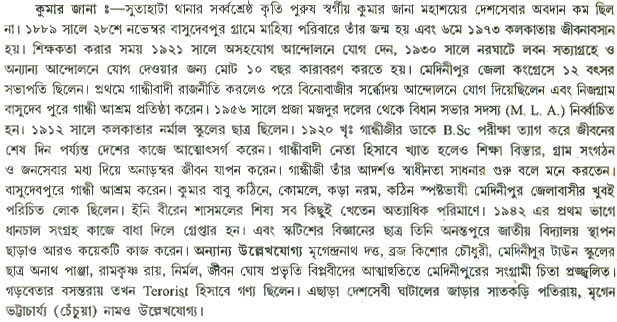
Kumar Chandra Jana was born on 28 th Nov 1889 in Basudevpur village of Sutahata Thana in Midnapore district. In 1912 he was a student of Normal School. CalcuttaHe did not sit for his final Exam. in B.Sc. in 1920 and joined the Non-cooperation movement at the call of Gandhiji . He remained in police custody for to years in 1922-23. He was also imprisoned in 1930 for joining in /non-cooperation movement. In 1935, he remained underground in his own village, founded Gandhi Ashram there, and lived there with his wife. He remained in jail for 1942-45 for joining in Quit India movement in 1942. The first mouth piece of Sarbodaya Sangha namely "Gram Seva" was published in 1948 by Kumar Chandra and edited by him.He joined All India Workers and Peasants Party in 1951 and elected as an MLA in 1952 election. When Binobaji came to Midnapore, he was influenced and joined the Bhudan movement giving up the MLA-ship.
Friday, September 27, 2013
151. Kiran Sankar Roy (1891-1949)
|
Roy, Kiran Sankar (1891-1949) a scion of the
Teota Raj, was the son of Harasankar Ray Chaudhuri. Although his formal
education began at the Teota Academy, he passed the secondary level ‘Entrance'
examination from Hindu School, Calcutta. He joined St Xavier's College, and
subsequently Bangabasi College, from where he did his IA (Intermediate Arts).
Around this time, the teenage Kiran Sankar developed links with the
extremist-terrorist movement. He was sent to England in late 1909 for his
university education, and joined New College, Oxford, around 1910. Roy was a
prominent member of the Oxford Indian Majlis and was President for a term. He
took his BA (Oxon) degree with honours in History in 1913.
Back
home, Roy joined the Congress, and became the vice-principal and professor of
English literature at the ‘national college' (Kalikata Vidyapitha), with
subhas chandra
bose as principal
A
disciple of CR Das joined the Swarajya Party when it was formed at the Gaya
Congress (1922) under the leadership of Motilal Nehru and CR Das. He became the
secretary to the Swarajya Party in 1923, and was elected to the Bengal Council,
for two consecutive terms. When the Civil Disobedience Movement got under way in
1930, Roy was arrested a second time, along with Subhas Bose, for leading an
illegal procession in Calcutta.
A
prominent figure in Bengal Congress politics for almost thirty years, Kiron
Sankar had been a member of the Bengal Provincial Congress Committee and the
All-India Congress Committee since 1922 and held important positions in both its
parliamentary and non-parliamentary wings. In the 1937 elections held in
accordance with the provisions of the 1935 Act, Roy was elected to the Bengal
Legislative Assembly. He was Leader of the Congress Party, and Leader of the
Opposition, in the Bengal Assembly in the late 1930s and
1940s.
After partition, Kiran Sankar Roy was for some time the Leader of the
Congress Party in the East Bengal Legislative Assembly, and also the Leader of
the Opposition and of the Congress party in the Pakistan Constituent Assembly.
He later resigned his membership of both the assemblies, and joined Dr BC Roy's
West Bengal cabinet as Home Minister on March 4, 1948. He died shortly
afterwards, at fifty-seven, on 20th February 1949.
Kiran Sankar was a key figure in the complex, clique/faction based
and Calcutta-centric Congress politics of Bengal, following the death of CR Das
in the mid-twenties. Roy played a central role in the turbulent decade of the
forties. He was prominently among (along with Sarat Chandra Bose) the handful of
Congress politicians who made a determined attempt at resisting the proposed
partition of Bengal. Roy and Bose, in
open conflict with the Congress High Command, came to an eleventh-hour agreement
with Suhrawardy and Abul Hashim for the creation of a ‘United and Sovereign
Bengal' and a ‘Free (Socialist) State of Bengal'; however, this plan did not
succeed.
Apart from his role as a politician, Kiran Sankar made significant
contributions to Bengali literature. He was a prominent member of the ‘Sabuj
Patra' group led by pramatha
chowdhury, and of sukumar
roy's celebrated ‘Monday Club'. Roy's essays and short stories
(in the ‘Sabuj Patra', ‘Prabasi', ‘Atmasakti' and other publications) were
appreciated by a large section of readers, and well received by critics. He
published a collection of short stories under the title of ‘Sapta Parna'.
Kiransankar Roy Chaudhuri was married to Padma Devi, of the zamindar family of
Kirtipasha, Barisal. [R
Roy].
|

149. Kiran Chandra Mukhopadhyay (1893-1954). 150. Kiranbala Rudra (1899 - ?)
Kiran was born in Jessore. He was a freedom fighter, a revolutionary and a renowned journalist. He started his revolutionary life from 1905 under Debabrata Basu (later known as Swami Prajnananda). He remained under when a warrant had been issued in his name for writing two revolutionary books, 1. Mukti Kon Pathe" and "Kwa pantha" published in "Hitabadi". he established two organisations namely, 1. " uttar Kolkata Yubak sangha" in Nayan Chand Street of north-Calcutta ande "Maheshalaya." He was caught red handed and undergone rigorous imprisonment after trial for one and half years for making explosives in Maheshalay.
He was arrested and imprisoned for being involved in India-German conspiracy of during WWI in 1916-19. At this period he was involved in founding Saraswati Press. He had undergone rigorous imprisonment for five years along with Gopinath Saha and others for murdering Arnest J.K. mistakenly to kill Treggart Saheb in 1924. He was the main shelter of the revolutionaries of Chittagang Armoury Raid in 1930 and was in chrge of preparing crackers in Dalhousie and remained again in custody from 1930 to 1937. He was kept confined during 1942 - 45 during Quit India movement. After being released he passed his life with students and youths organising "Prajnananda Pathagar'.
Kiranbala was born in Bikrampur Dhaka. She was influenced by the Folk Drama and Patriotic song of Mukunda Das.Breaking all the obstruction of her father-in-law's house she joined the freedom movement in 1930.They established a nationalist post office in Vikrampur in 1931. She remained imprisoned for one year and eight months for joining in civil disobedience movement in 1932. She was again arrested in Oct. 1942 and was punished by the court for two years imprisonment. She was released after one year for break down of her health. She joined in Bhudan Movement.
He was arrested and imprisoned for being involved in India-German conspiracy of during WWI in 1916-19. At this period he was involved in founding Saraswati Press. He had undergone rigorous imprisonment for five years along with Gopinath Saha and others for murdering Arnest J.K. mistakenly to kill Treggart Saheb in 1924. He was the main shelter of the revolutionaries of Chittagang Armoury Raid in 1930 and was in chrge of preparing crackers in Dalhousie and remained again in custody from 1930 to 1937. He was kept confined during 1942 - 45 during Quit India movement. After being released he passed his life with students and youths organising "Prajnananda Pathagar'.
Kiranbala was born in Bikrampur Dhaka. She was influenced by the Folk Drama and Patriotic song of Mukunda Das.Breaking all the obstruction of her father-in-law's house she joined the freedom movement in 1930.They established a nationalist post office in Vikrampur in 1931. She remained imprisoned for one year and eight months for joining in civil disobedience movement in 1932. She was again arrested in Oct. 1942 and was punished by the court for two years imprisonment. She was released after one year for break down of her health. She joined in Bhudan Movement.
Thursday, September 26, 2013
147. Kiran Chakrabarty (1921 - ?). 148. Kiran Chandra Mitra (1883-1954)
Kiran was born in Nrayangang Dhaka, His great maternal uncle was a leader of Anushilan Revolutionary organisation, named Ramesh Acharya. Kiran was being brought up in an atmosphere of the Congress. The house, Manabari, attached to their own house was the shelter of the political workers at that time. He joined, in such circumstances, to the Revolutionary Socialist Party. He remained underground in his own house. at the time Quit India Movement his maternal uncles were arrested and he had to take the leadership of the movement.At the end of 1942, he was arrested and remained in police custody. He was released in 1945. He became member of the working committee of RSP in Narayangang. His political work was suspended during the communal riot of 1946-47. He had to come to West Bengal after partition of India.
Kiran Chandra was a leader of labour movement. He had given up his service to oppose the misbehabiour of the Employer to the workers. He had to go to prison for conducting the historical Strike of the workers of 1928. He took the leadership of editing papers in Hindi, English and Bengali to write in favour of workers. At the Congress Session of 1928 held in Park Circus Maidan, he took the lead of the rally of 50 thousands workers covering a length of 2 miles inside the session to picket in support of their demands.
Kiran Chandra was a leader of labour movement. He had given up his service to oppose the misbehabiour of the Employer to the workers. He had to go to prison for conducting the historical Strike of the workers of 1928. He took the leadership of editing papers in Hindi, English and Bengali to write in favour of workers. At the Congress Session of 1928 held in Park Circus Maidan, he took the lead of the rally of 50 thousands workers covering a length of 2 miles inside the session to picket in support of their demands.
Tuesday, September 24, 2013
146.Kichlew, Saifuddin (1888-1963)


Saifuddin
Kitchlew
| Saifuddin Kitchlew | |
|---|---|
| Born | January 15, 1888 Amritsar |
| Died | October 9, 1963 (aged 75) Delhi |
| Nationality | Indian |
| Ethnicity | Kashmiri |
| Occupation | freedom fighter, politician |
He was awarded the Stalin Peace Prize (now known as Lenin Peace Prize) in 1952.
Early life
Saifuddin Kitchlew was born to the Kashmiri Muslim family of Azizuddin Kitchlew and Dan Bibi on January 15, 1888, in Amritsar, Punjab. His father owned a pashmina and saffron trading business and originally belonged to a Brahmin family of Baramulla. As it was his ancestor, Prakash Ram Kitchlew, who had converted into Islam and later his grandfather, Ahmed Jo migrated from Kashmir in mid 19th century to Amritsar after of the great Kashmir famine of 1871.Kitchlew went to Islamia High School in Amritsar, and later obtained a B.A. from Cambridge University, and a Ph.D. from a German university, and began practicing law in India.
Career
On his return he established his legal practice in Amritsar, and soon came in contact with Mahatma Gandhi. In 1919, he was elected the Municipal Commissioner of the city of Amritsar. He took part in the Satyagraha (Non-cooperation) movement and soon left his practice, to become part of the freedom movement, as well as the All India Khilafat Committee.Political career
Jallianwala Bagh
Dr. Kitchlew was first exposed to Indian nationalism when the whole country was outraged by the Rowlatt Acts. Kitchlew was arrested with Mahatma Gandhi and Dr. Satyapal for leading protests in Punjab against the legislation. To protest the arrest of the trio, a public meeting had gathered at the Jallianwala Bagh, when Gen. Reginald Dyer and his troops fired mercilessly upon the unarmed, civilian crowd. Hundreds of people were killed, and hundreds more injured. This act, the worst case of civilian massacre since the Indian rebellion of 1857 outraged the nation, and riots broke out all throughout the Punjab.Political mainstream
Kitchlew rose in the Indian National Congress, first heading its Punjab unit, and then rising to the post of AICC General Secretary, an important executive position in 1924. Kitchlew was also the chairman of the reception committee of the Congress session in Lahore in 1929-30, where on January 26, 1930, the Indian National Congress declared Indian independence and inaugurated an era of civil disobedience and revolution aimed to achieve full independence.Kithclew was also a founding leader of the Naujawan Bharat Sabha (Indian Youth Congress), which rallied hundreds of thousands of students and young Indians to nationalist causes. He was also the member of the Foundation Committee of Jamia Millia Islamia, which met on 29 October 1920 and led to the foundation of Jamia Millia Islamia University.
He started an Urdu daily “Tanzim” to uplift the Muslims and was instrumental in establishment of Swaraj Ashram in January 1921 at Amritsar to train young men for the national work and to promote Hindu-Muslim unity. Throughout the 1930-1934 struggles, Kitchlew was repeatedly arrested, and in all spent fourteen years behind bars.
Post Independence
Dr. Kitchlew was opposed to the Muslim League's demand for Pakistan and later in the 1940s became President of the Punjab Congress Committee. In 1947 he strongly opposed the acceptance of the Partition of India by the Congress Party. He spoke out against it at public meetings all over the country, and at the All India Congress Committee session that ultimately voted for the resolution. He called it a blatant "surrender of nationalism for communalism". Some years after partition and Independence, he left the Congress. He began to come closer to the Communist Party of India. He was the founder president of the All-India Peace Council and also remained President of 4th Congress of All-India Peace Council, held at Madras in 1954, besides remaining Vice President of the World Peace Council.He also got the award of Lenin Prize from Soviet Union in 1954.
Dr. Kitchlew moved to Delhi after their house was burnt down during partition of India riots of 1947, thereafter he spent the rest of his years working for closer political and diplomatic relations with the USSR, and received the Stalin Peace Prize in 1952, which was renamed for Lenin Peace Prize under De-Stalinization. In 1951, a Government Act made him, Jawaharlal Nehru, and Maulana Abul Kalam Azad, life trustees of the Jallianwala Bagh National Memorial Trust.
He died on October 9, 1963, survived by a son, Toufique Kitchlew, who now lives in a Lampur village on the outskirts of Delhi, and five daughters. While four of his daughters were married into Pakistan, (two survive to date), one daughter, Zahida Kitchlew, was married to the Malyalam music director M. B. Sreenivasan, a Hindu gentleman.
Legacy
A posh urban suburban colony in Ludhiana, Punjab is named after Dr. Saifuddin Kichlew. It is popularly called Kitchlu Nagar.Indian Post released a special commemorative stamp featuring him in 1989. The Jamia Milia Islamia created a Saifuddin Kitchlew Chair at the MMAJ Academy of Third world Studies in 2009
Subscribe to:
Posts (Atom)