On 25th May 1972, in presence of Nazrul Bangladesh celebrated his 73rd birth day with great grandeur. In-spite of heavy rain fifty thousand people assembled in front of Kabi Bhavan to pay respect to the National Poet Kaji Nazrul Islam.
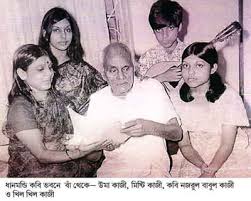
After coming to Bangladesh the poet was seen to be improving. His waist pain was removed after treatment. Under the guidance of Dr. Nurul Islam, a medical board consisting of Dr. Usuf Ali, Dr. Nazimudollah Chowdhury, and Dr. Ali Ashraf was formed for regular check up of Nazrul Islam. Arrngments were made for songs played infront of Nazrul in the morning and in the evening for his listening. the poet became cheerful . He was taken out regularly by car to move around which he liked.
In a special convocation in 1974, the Dhaka University conferred D.Lit to Nazrul Islam for his contribution in literature. The felicitation paper was read by the Vice-Chancellor Dr. Abdul Matin Chowdhury;
On 25th Jan 1975, the then Chancellor of Dhaka Viswavidyalay, Rashtrapati Mahamudollah in a special ceremony in Banga Bhavan conferred the degree of D.Lit. to Dr. Nazrul Islam. On that day the poet walked on the green lawn without any help and made others aback. In 1976, Bangladesh Govt. offered him citizenship of Bangladesh and awarded " Ekushe padak" on twenty first February.
The poet was at first looked after.
by Uma Kaji, wife of Sabyasachi Kaji. When she left Kabi Bhavan on 14 Dec 1974, an young devotee of Nazrul, Safi Chakladar took the responsibility of his look after. He became the caretaker of Nazrul till he was shifted to P.G.Hospital on 22nd July 1975. Apart from this /kishore Sah Kushar who served Nazrul for the last 42 years also stayed with him.
The poet lived in the house at Dhanmodi for two and half years and he liked the place.It was learnt from Safi Chakladar that the poet used to sleep in the night in this open environment. To go to upstairs if he could go alone, without any help, if he was left at the corner of the turning point of the stairs to go to the 1st floor. After practice he could take tea and drink by himself and used to observe TV and came to the TV room by himself. If one pretended to throw something to him, hew tried to save himself by his hand. When was removing to take him to P.G.Hospital on 22nd July 1975, he tried to obstruct by holding the rellings of the stairs. 117 no. Cabin of the hospital was his last resort and he stayed there upto 29th Aug of 1976.
His body was filledwith fluids and he looked fat.On 27th Aug he had some fever which swelled upto 105 degree.He was given oxygen and his congested cough from his lunge was trying to be removed. The medical board appointed for his treatment under theguidance of Dr. Nurul Islam, Dr. Nazimuddin Chowdhury tried their level best for his treatment but he expired in the morning of 29th Aug 1976.
This was announced i-by TV and Dhaka Radio.
A huge rally followed the funeral procession of Dr. Nazrul Islamn. Two days state mourning was observed. Both in calcutta and Bangladesh people observed the mourning of KajinNazrul Islam.
In the courtyard of the mosque at Dhaka University.
Last time Nazrul went to Dhaka when he was in full form on 12.12.1940 to attend first anniversary of AIR, Dhaka. After partition of India into two countries, India and Pakistan, on 15 th Aug 1947 he did not come to Dhaka or to any place of East Pakistan (East Bengal). There were many attempts to bring him to East Pakistan, even after his illness, but he did not respond. After the formation of Independent and Sovereign country "People's Republic of Bangladesh", the India Govt. granted permission to take him to Bangladesh at the request of the Prime Minister of Bangladeesh,
He was then brought to Bangladesh by a special plane ,along with his family, on 24th May 1972. When the plane reached the airport at Tejgaon , Dhaka, at about 11.40 am, a huge gathering awaited in the airport to welcome him. He was then taken to Dhanmondi, 28 Street, fixed as his residence in Bangladesh, by an ambulance From Airport. Rashtrapati Abu Saheed Chowdhury (below)and Prime Minister Sheikh Mujibur Rahman came to Kabi Bhavan to show their respect to the Poet Nazrul Islam. It is noted that the Rashtrapati and Prime Minister came earlier to see his well being. This is also to be noted that after being Independent country the Govt of Bangladesh sanctioned the song of Rabindranath Tagore, "Amaar sonar Bangla, ami tomay Bhalobasi" as the National song of Bangladesh and the song of Nazrul, " Chal.Chal,Chal" as its war-song. Rashtrapati Abu Saheed Chowdhury said to Naxrul to bid him respect. The Prime Minister Skeikh Mujibur Rahman on behalf of the Bangladesh Govt sanctioned Rs 1000/- pm as a grant to the poet Nazrul. A govt official, not below the rank of deputy secretary, would bring the cheque containing the amount at the beginning of every month.
Pramila Nazrul fell ill in 1939. She was bedridden for the next 23 years with her full senses. Her downward portion became paralyzed but the upper portion of her body was perfectly alright.She got the first mental shock at the death of her son "Bulbul" in 1930. The second sock she got when she herself became ill, in 1939. The great shock in her life was the illness of her husband , Nazrul, in 1942 and the last shock she got in 1946 when her mother made herself scarce. Though she was torn ed by shocks after shocks, she did not break down. Being bedridden she looked after her household affairs and her family members specially her husband.At last on 30th June, 1962, at the age of 54 ( born in May, 1908), she expired keeping his deceased husband and two sons. She was put in the grave, as she desired, by the side of "Shar Pukur" of Churulia.
The eldest son of Nazrul, Kaji Sabyasachi (left) and the youngest son Kaji Anoruddha (right) were born in 1929 and 1931 respectively.
Sabyasachi was a renowned performer in recitation and Aniruddha was a famous musician. he prepared the tuning note (swaralipi) of rare and unpublished lyrics of Nazrul and published them..
Aniruddha died on 22 Feb 1974 at the age of 43 and Sabysachi died on 2 March 1979.
Nazrul fell ill in Calcutta AIR Station on 9th July, 1942. At the time of his illness the family of Nazrul had rendered penniless because he had of no other source of income. Moreover, he had no savings and he became debt-ridden.His wife at that time was also ill and bed-ridden. His elder son Kaji Sabhysachi was then twelve years old and Kaji Anirudda was 10 years old. The poet Julfikar Hyder informed the Chief Minister A.K.Fazlul Haq about the illness of Nazrul and his economic condition. The Chief Minister Haq Saheb requested Dr.Shyamaprasad Mukherjee, one of his cabinet minister, to arrange for his treatment. Dr.Mukherje immediately went to Nazrul and gave him some collected money of Rs. 500/- for going to Madhupur for his change of weather.The poet along with his family went to Madhupur on 19th July, 1942. At Madhupur Nazrul was under the treatment of Dr. Sarkar, a Homeopathy Doctor. But even after the lapse of two months stay, no improvement was perceived. As a result the poet returned back to Calcutta with his family on 21st Sept 1942. The Nazrul was under treatment of Dr. Bimalananda Tarkatirtha, the Physician of Rabindranath Tagore. At first there were some improvement but soon Nazrul became mentally unbalanced and he was transferred to The Mental Hospital at Lumbini Park where he was under the treatment of Dr. Nagendranath De and Dr. Girindra Shekhar Basu. Nazrul stayed in Lumbini Park for four months.But even then there were no improvement and he was taken back to his house in Jan 1943.. Nazrul was then deeply immersed in economic depression and his treatment happened to be stopped. Under these circumstances A committe named "Nazrul's Relief Committee" was formed with Dr. Shyamapada Mukherjee being the President and Treasurer, Sajani Kanta Das and Julfikar Hyder as Jt. Secretary, and Said Badruduzza, and with 9 important persons as .members, such as, Said Badruduzza, Sire A.F.Rahman, Tarasankar Bandyopadhyay, Humayun Kabir, Bimalananda Tarkatirtha, Satyendranath Majumdar, Tushar Kanti Ghosh, Chapalakanta bhattacharya, and Gopal Haldar. This committee handed over Rs. 200/- pm to the family of Nazrul for five months. An "Aid-fund of Nazrul "was formed by the Muslim Students of the Taylor Hostel and collected a good amount of money and helped Nazrul for three months at the rate of Rs. 200/- pm. but no help reached to the wife of Nazrul after that. Prof. Saidur Rahman was the president, Abdul Hakim the secretary, Riyajul Islam the Jt.sectetary of the above committee. When all such non-official committees failed, the Govt. of undivided Bengal granted a grant of Rs. 200/- pm to Nazrul as a grant for his literary work. After the partition of Bengal the "Shitya Sangsad of East Pakistan " demanded from East Bengal Govt a grant of Rs. 1000/- and the minister Habibullah Bahar of East Bengal Govt. granted Rs.150/- pm as a special grant for his literature but due to the complication of his residence being in Calcutta situated in West Bengal his family could not draw the grant for about two years. Ultimately arrangements were made for the payment through the "Coomillah Banking Corporation " and then through the Calcutta Deputy High commissioner of Pakistan. Nazrul passed a life of forgotten-memory after his illness for ten years. Nazrul was awarded " Jagattarini Golden Medal" by Calcutta University in 1945 and he also received some help from Non-Govt. sources for his treatment.
On 27th June of 1952, the important litterateurs of Calcutta formed a committee, named "Nazrul's Recovery Committee" with Kaji Abdul Adud as the General Secretary. With the help of that Committee, the poet and his wife was sent to the Ranchi Mental Hospital on 25th July 1952 for treatment.He was under treatment of Major Davis there for four months but he was not even diagonised at that place. The "recovery committee " then sent him to abroad for treatment. Rabiuddin, on behalf of the "Recovery committee" started for London with Nazrul, his wife Pranila and his son Aniruddha by ship on 10th May 1953 and reached there on 8th June . Amedical Board was formed to examine Nazrul consisting of Dr. a.E.baton, Dr.William, And Sir Russel Brain and found no hope for his recovery. Though Dr. A.E.baton and Dr. Sir Russel brain had different opinions. According to Sir Russel the Brain of Nazrul was deformed in such a way that there was no chance of his recovery because the forehead of Nazrul had contracted severely. a team od Doctors of London diagnosed Nazrul to be suffering from "Involutional Psychosis". Dr. Wily Macfik advised Nazrul for brain surgery which was opposed by Dr. Brain. Still all the doctorsof London were of same opinion that there was gross neglect in the primary treatment of Nazrul. Nazrul was then taken to Vienna and remained under the treatment of Dr. Hans Hoff. In his opinion Nazrul was suffering from "Pix disease" and there was no chance of recovery. Nazrul and his wife were then taken back to india on 14th Dec 1953. The reports of his treatment were sent for further opinion to the specialist in Russia and learnt that they had nothing to do at present. since the on every 11th Jaishtha Nazrul jayanti was observed in full swing.In 1960 the Govt. of India awarded him "Padmabhushan".
Five books of Nazrul were confiscated by the then British Govt. in the twenties of twentieth century. The five. The books were, 1. Yugabani, 2. Bisher Bansi, 3. Bhangar Gaan, 4, Pralay Shikha, and 5. Chandrabindu. The first one 1. is a book containing essays, the next three , 2-4 are books on verses, the last one, 5. a book on lyric.There were some other books which were ordered for confiscation but was not done. The books were Agnibina, Sanchita, Phanimansa, and Sarbahara of lyrics and Rudramangal a book on essays.The essays of Yugabani were published in Oct 1922 which contained 21 essays. The first twenty was published in evening daily "Nabayug" as essays and the last one, "Jagarani", was published in the magazine "Bakul" titled "Udbodhan"in Ashar, 1327 (1920). In 1922, Yugabani was confiscated by the then Govt. of Bengal on a criminal charge of the rule 995 of anti-Govt. activity ( gazette notification of 1666 of 23 Nov 1922). In the opinion of the Govt three of these essays - "Dayerer Smritistamva", "Mahajirin Hatyar Janya Dayee Ke?" and "Bangla Admike Guli Mara" were objectionable. It were also banded by Central Province and Burma Govt. Just on the verge of declaration for Independence of India the order for confiscation was withdrawn (Gazette notification of 396 dt. 31 March 1947).
Bisher Bansi was published in Shraban 1331 (1924). Though it was confiscated still its publicity could not be stopped.
The demand for withdrawal of the order of confiscation on the books of Nazrul began at the thirties of Twentieth Century. It became accelerated after the removal of withdrawal notice of Pather Dabi of Sarat Chandra Chattopadhyay. But the withdrawal notice was not issued before 1945. it began on and from 27th April 1945. The first proposal of the order of the Confiscation on the book "Bisher Banshi" was raised in the Bengal assembly by Maulabi Md. Fajlullah on 11th Aug 1930, Mr. W D.R.Prentice, in-charge of the Dept. of politics replied his proposal which Chief Minister Mr. A.K.fazlul Haq replied on 16th Jan 1941 " Muslims complain and very naturally that worse books by Hindu Authors have in many cases been released from proscription and they resent these orders in case of Muslim authors. This order was again reiterated to continue by the Home Dept. of Bengal Govt.
was not satisfactory and the proposal was again raised in the assembly in 1939. It is to be noted that from 1937 to 1941 the Ministry in the undivided Bengal was formed by Muslim League and Krishak Praja Party of fazlul Haq. The important litterateur and political person Humayun Kabir put several question in the Bengal Assembly on 10 feb 1939 which was answered by the then Home Minister Khaja Nazimuddin claiming that those books were full of seditious activities he further declared that the order for confiscation could not be withdrawn . From that time many notes on this order of confiscation was exchanged in the intra-dept. of Govt. authorities between 1939 to 1941. Lastly, Mr. R.H. Hachings, secretary of the dep. of politics replied " the books were all objectionable and seditious. The ban should not perhaps be removed. In the beginning of the life of Nazrul and Muzaffar Ahmed as a litterateurs they tried their level best to publish daily " Nabayug" with the assistance of This A. K. Fazlul Haq since 12th July 1920 and when it again started publication after some time at the end of his life from1941 as chief editor and remained in the same position till he fell ill. This was revealed in the current issue of Nabayug (left)
Having returned from army Nazrul was staying in the office of the "Bangiya Musalman Sahitya Samity
and at the end of his life as litterateur he delivered his most important lecture after twenty one years on 5th and 6th April 1941 in the silver jubilee session of the conference of " Bangiya Musalman Sahitya Samity" as a president;
Probably the poet could have been known his tragedy at the end of his life as litterateur and wrote "yadi aar banshi na baje"
This poem was recited by the poet Nazrul in AIR and this was recorded in the title "Rabi hara" after the death of Rabindranath Tagore in Aug 1941 (22 Shraban 1348).
Nazrul constructed lyrics at the death of Rabindranath Tagore "Ghumaite dao shranta Rabike"., "salam astarabi"
Nazrul wrote Motayer hosen in a letter dated 24.2.28 ;
" Rabindranath often said to me , look my dear insane, you are waiting a trajedy like Shelley or Keats, some trajedy will befall you very soon". Actually it so happened and not before the completion of one year. Nazrul became "insane" in July 1942 and Tagore died in Aug 1941.
Nazrul wrote an essay in Nabayug in June 1942 titled "Aamar Sundar" in which he mentioned;
An ugly essay criticizing Nazrul's essay titled "Amaar Sundar" was published in the magazine "Krishak" titled "Sundaram".
It was learnt that while reading the essay "Sundaram" AIR, Calcutta, on 9th July 1942, Nazrul fell ill. At that time he had a programme of 10 minutes to tell stories for children in AIR but he stopped suddenly and could not proceed due to illness. The programme director Nripendra Krishna Chattopadhyay was a friend of Nazrul and he immediately shifted Nazrul by a taxi to his house. The poet was first examined by Dr.D.L.Sarkar. Under his treatment for about a week, there was no improvement of his problems.The trembling in his hand and lost sensation of his tongue were not regained, rather began to increase..
Nazrul could not have any entry in Gramophone Company before 1928, though his song was recorded in 1925 in His Master's Voice Company. Nazrul had written a drama while he was staying in Berhampore Jail at the request of his co-prisoner Purna Chandra Das, the principal of Madaripur Peace Volunteer Force for his Charan Dal. But it was misplaced while delivering secretly outside the jail. There was a lyric in that drama, " Jat Jaliat" which was published in " Bijali' in the 4th Shraban issue of 1330. In the book "Bisher Banshi" the lyric was printed as "Jater naame bajjati Sab". This lyric was used in the play "Palliseba" by Charan Kabi Mukunda Das . The famous artist Harendranath Dutta recorded the song in 1925 in Mixed Paraj Tune. " Jater naame Bajjati sab jat jaliat " which was recorded by HMVP 6945 and another song was also recorded in that disc". Punthir bidhan Jak Pure" was recorded by him also in 1928.
Prantosh Chattopadhyay wrote in his book that Harendranath Dutta came to Hooghly to learn the song "Jater naame bajjati sab, jat jaliat " from Nazrul to record the song in His Master's Voice. In the bulletin of His Master's Voice of 1925 issue, it was mentioned that Harendranath Dutta would record two patriotic songs. It was curious that in the second one, it was mentioned that the song was constructed by the poet Kazi nazrul Islam.
Nazrul became the lyric writer and director of Music dept. of His Master's Voice from 1928 to 1932. as per contact no one was allowed for tuning Nazrul's song.. Angur Bala recorded two songs Nazrul , such as,
" Bhuli Kamone", and "Ato Jal o Kajal" , Nazrul's recitation and Song sung by K.Mallik, "Bagichay bulbuli tui" and "Amare chokh isaray dak dile hi" were also recorded.
All those songs were recorded in April 1928 and published at the end of the year.
In 1929 six artists recodrded 10 songs of Nazrul. The names of the artists were Angurbala, Indubala, Manikmala, Umapada Bhattacharya, K.Mallik and Prativa Som (Basu). The two songs she recorded were " Smarana Parer Ogo Priya", and "Charite Parana Nahi Chay". The records were published in 1929.
Thus the artists Nazrul became a teacher in Music after joining in Gramophone Company..
He also worked in Megaphone Company for one year, 1932 to 1933. Nazrul sold his right of these records to the Megaphone Company. For this reason his songs were allowed to be tuned by others and actually the tuners like Gnan Dutta , Bhismadev Chattopadhyay etc subsequently tuned many of those songs.There were two songs sung by Dhiren Das, Joybani Bidyadayini, and Laksmi Ma tui.
Nazrul then again came back to HMV as a composer with written contact. The recorded songs of Nazrul became the property of the Company and the company got the legal right of tuning the songs by other tuner.. There were some examples of mis-using the right.
Nazrul also worked in Columbia in 1939 over and above these two companies. He also worked in Pioneer, Senola, Hindusthan Gramophone Record Company etc. Many songs were recorded with twin level. All the then singer and tuner came in contact with Nazrul at that time i.e., in thirties.
From 1928 to 1942 Nazrul recorded many Gazals, Islami Songs, Shyama Sangeet etc as also Tappa, Kirtan, Bhajan, Devotional songs .
At the end of thirties huge number of listeners were used to listen All India Radio. From Aug 1927, broadcasting of items in radio were started and in Dhaka it was started from Dec 1939, broadcasting the message of Rabindranath TagoreOn 12.11.29 nazrul Recited "Nari" in AIR, Calcutta. His co-artists were Haridas Goswami, Gouri Chakraborty, Sushama Devi etc. From 1932, The drama Mahuya of Manmatha Roy was broadcast-ed of which Nazrul constructed the songs. The Geetialekya " Jiban srot"of Jagat Ghatak with songs constructed by Nazrul was broadcaste-ed in 1936. Nazrul was the anchor and director of the death anniversary of Dwijendra Lal Roy observed by AIR in 1937. Dilip Kumar Roy, son of Dwijendra lal Roy and his colleagues were the singers .
Nazrul used to broadcast in AIR from 1939. Not only in Calcutta AIR but also in Dhaka Nazrul participated in broadcasting different items.He continued till 1942 when he became seriously ill.
"Pralayollas"- "Tora Sab jayadhwani Kar" was one of the famous lyric and song of Nazrul created in 1922.In 1923 when he was in Hooghly Jail he constructed, " Sikal parar Gaan" - Ei sikal para chal moder, ei sikal para chal.. these songs created in the time of Non-cooperation movement were published in " Bisher Bansi" and "Bhangar Gaan" . Both the books were banded by the then Govt.
In 1926, Nazrul gave new dimension to the world of his music. He added anti-communal and anti-feudalistic ideas in his patriotic songs. In 1926, the Bengal Congress Session was held in Krishnnanagar and Workers Swaraj Party or Sramik Praja Swaraj Party their first conference in that place. Nazrul constructed many such patriotic songs at that time. At that time his immortal creation was "Kandari Hushiar" - Durgama giri kantara maru dustara parabara he' .
Trotsky follower Somendranath Thakur commented on Nazrul's song;
At this time Nazrul became a creator of patriotic songs and also a creator of Samybadi Mass songs.




.jpg)
.jpg)
.jpg)


